IT'S XIAOTIME!

Naglilingkod sa Diyos at sa Bayan sa pagtuturo ng Kasaysayan

Category: Uncategorized

AN OLD BANDUNG-RELATED BOOK REVIEW

To celebrate Sejiwa: The Spirit of Bandung at 70: A Hybrid International Conference on the Asian-African Conference of 1955.

Laurel Report: Mission To China
By Senator Salvador H. Laurel
Manila, April 1972,
185 pages

Reviewed by Xiao Chua in 2003.

This is basically the report by then Senator Salvador “Doy” Laurel to Senate President Gil J Puyat on the merits of his official journey to China on 12-22 March 1972, a few months before President Ferdinand Marcos’s declaration of Martial Law and the abolishment of the Senate.  This is a very interesting document because it was an insider’s glimpse of how China and the Philippines dealt with each prior to the establishment of formal diplomatic relations with the People’s Republic Of China—both politically and culturally.  In 1949, when the PRC was established, under American influenced, we broke our diplomatic ties with China, with the impression that Communism is against the principles of democracy.  The book is also interesting as it touched many issues on China then that greatly affected Asian diplomacy even to this day.

On the invitation of the Chinese People’s Institute of Foreign Affairs, Laurel embarked on a journey to China accompanied by, among others, his lovely wife, Mrs. Celia Diaz-Laurel, who became his secret weapon as she became the diarist, photographer and interpreter in Mandarin!  His mission:  gather data and materials that would be useful to the re-opening of trade relations with China as the one and only committee member to make an observation tour of that country.  Within his ten-day visit, he met various Chinese ranking officials.  They planned to meet Premier Chou En Lai, but the contingent decided to leave on 21 March. Nevertheless, Laurel’s discussions with lower ranking Chinese officials were very substantive.

To understand Chinese foreign policy, one should know their five principles promulgated at the Bandung Conference (or the Pancha Sila), it’s their Bible in diplomacy:  “1.  Mutual respect for each other’s territorial integrity and sovereignty, 2.  Mutual non-aggression, 3.  Mutual non-interference in each other’s intern affairs, 4.  Equality and mutual benefit equality and, 5.  Peaceful co-existence.”[1]  This could be seen with their statement, a direct attack on American imperialism,[2]

The People’s Republic of China will never be a superpower.  We belong to the Third World.  To be a superpower is to interfere with the affairs of other nations.  To be a superpower is to dominate and control other nations.  It means bullying weaker nations.[3]

China expressed their desire to resume diplomatic relations with the Philippines stating the fact that we’re really natural neighbors and that we’ve been friends for a thousand years and was only interrupted for 23 years.  But before resuming relations, the Philippines should have a common view with them on the Taiwan issue.  Laurel agreed with this saying that “the Two-China policy is unrealistic, deceptive and wishy-washy policy. Recognizing Taiwan as the government of China in effect means that Taipei is the seat of government of the 800 Million Chinese in the mainland.”[4]

The Philippines’ claim on the on the oil-rich Spratley Islands, also known as Freedomland, was also brought up in the discussions.  According to the Chinese, they always regarded the islands as theirs, even called it Nansha Islands but said that it wasn’t yet the right time to talk about the issue because of the absence of diplomatic relations.[5]

Laurel asked if the anti-Maoist Anti-Subversion Law would be an obstacle in China-Philippine Relations.  Take note that Mao Zedong was still alive at the time Marcos declared war to the communists in the Philippines for their adherence to the Marxist-Leninist-Mao Zedong thought.[6]  The Chinese answered that it’s an “internal problem that is up to the Philippines to resolve.”[7] 

About trading, the Chinese said that they could “trade only on an unofficial or non-governmental or people-to-people basis.”[8] (Italics supplied)  They couldn’t deal with the government because of the absence of diplomatic relations, and to have diplomatic relations, it is crucial to do away with the Two-China policy.

Considering all that was said, Laurel recommended that the Philippines do away with the policy of fear and ignorance towards China and the policy of subservience towards America that hinders us to have diplomatic relations with China.  That if we would like to trade with China as a nation we should agree that there is only One-China, and its Central government is in Beijing.  Laurel said,

Philippine-China relations have hitherto been one of snobbery, if not outright hostility.  Our two peoples have been separated by a curtain of ignorance and mistrust….[9]  We should forget the prejudices of the past and look forward to the promise of the future….  Finally, we are making it known that, paraphrasing the words of the great Recto, “We shall make no enemy if we can make a friend.”[10]

And after a few years, the Philippines and China re-established their diplomatic relations, adapting the recommendations of Laurel.

The rest of the book contains their China Diary that dealt mainly with cultural exchange with their Chinese hosts, texts of declarations and conferences such as the US-China Joint Communique, export and import corporations of the PRC, a primer on China, and the text of the Chinese Constitution as amended in 1954.  

The book was very indispensable if you want to know about the real and official stand of the Chinese government on issues three decades ago.  That’s why interested China watchers should consult first this book, and compare it with Chinese policy now and you’ll see that the Chinese government had become consistent on many issues but changed a bit with how they would deal with the United States.

In my opinion, Laurel had been very effective as a diplomat with his choice of words.  And the way he dealt with the Chinamen and the way he wrote the report were brilliant and very effective in convincing those concerned and in meeting his ends.  We should learn from his example.  For students of diplomacy, the Laurel Report:  Mission To China is a must read.

-11 March 2003


[1] Laurel, Salvador H.  Mission To China. ( Manila, April 1972), p. 75.

[2] Then—China is against the US and their brand of imperialism. Mao even called US a Paper Tiger. Now—China is taking a more friendly approach towards the US.  A reporter once wrote that since Mao met with Nixon in Feb. 1972, “The two countries have learn since then that they are doomed to live with each other….”  (Liu, Melinda.  “In Love With A Vision.”  Newsweek 20 September 1999, p. 40.)

[3] Laurel, p. 5.

[4] Ibid., p. 25.

[5] Yet, even with the establishment of diplomatic relations, the Spratley issue is everything but resolved.  In 1994, China asserted its claim by building two concrete structures at Mischief Reef or Panganiban, an area being claimed by the Philippines. (Magno, Alex.  “Naval Power Play Sets Off Alarms.”  Time 27 Sept. 1999, p.  106.)

[6] But when Marcos visited Beijing, he told the Maoists,

I am confident that I shall leave inspired and encouraged in our own modest endeavor in the creation of a New Society for our people, for the transformation of China under the leadership of Chairman Mao Zedong is indeed the most noble monument to the invincibility of an idea supported by the force of human spirit. (Italics mine—quoted in Benigno S. Aquino, Jr., Testament From A Prison Cell (Makati:  Benigno S. Aquino Jr. Foundation, Inc, 1984), p. 9.)

[7] Laurel, p. 12.

[8] Ibid., p. 9.

[9] Ibid., p. 25.

[10] Ibid., p. 42.

Two lessons from the El Filibusterismo

The Manila Times, Walking History Column

October 30, 2025

MICHAEL “XIAO” CHUA

JOSE Rizal’s “El Filibusterismo” is a sequel to his first novel, “Noli me Tangere,” which Penguin Classics declared as the first major artistic manifestation of Asian resistance against European colonialism. Hence, both are important not only in the formation and imagineering of the Filipino nation but also in the story of anti-colonial and anti-imperialist struggle in our continent.

According to Floro Quibuyen, in his book “A Nation Aborted: Rizal, American Hegemony and Philippine Nationalism,” when Rizal was asked by his brother Paciano to go to Spain in 1882, he was told by his brother that “the principal purpose” of his trip was not just “to finish this [medical] course but to study other things of greater usefulness.” This implies that the creation of a study or a work representing the past and the present of the islands at that time was their main objective. Hence, the “Noli,” the “El Fili” and the historical annotations to the “Sucesos de la Islas Filipinas” of Antonio de Morga were really the fulfillment of Rizal’s dream project.

The historian Augusto de Viana pointed out to me that, looking at the manuscript of the Noli, one may notice Rizal’s signature handwriting was still flowing. To cut the cost of printing, he placed lines on the side of the ejected manuscript on Elias and his lover, Salome, but still readable. The story was more playful, more satirical. But the manuscript of the El Fili tells a different story; the flowing handwriting had become more pointed. At first, perhaps knowing he would have lots of paper, he was just using the front side. Eventually, he will use the back pages and will have so many ink erasures in the text, many times whole pages, that they will not be easily recoverable. It was an angrier novel, owing to the context of the Rizal family’s expulsion from the Calamba friar land in 1890, and the lack of funds owing to friends who promised support for the writing of the novel but did not fulfill them. His depression often made him want to burn the manuscript, but the novel was saved by the financial help of his Kapampangan friend Valentin Ventura, and the novel was published in Ghent, Belgium, in 1891.

Crisostomo Ibarra, Noli me Tangere’s protagonist, re-emerged as Simoun in El Filibusterismo. His main goal is to agitate the people to rise up against the Spanish colonizers, hence the term “filibuster,” which in the Spanish colonial context meant a rebel. Simoun eventually failed, and this was read by many as Rizal’s warning against a revolution, being a reformer and a pacifist. That the Fili was an anti-revolution novel. But reading José Alejandrino’s memoir, “The Price of Freedom,” Rizal perhaps had a different message. Being his roommate in Belgium while finishing the novel, Rizal reportedly told him, “… I regret having killed Elias instead of Crisostomo Ibarra; but when I wrote the Noli Me Tangere, my health was badly broken and I never thought that I would be able to write its sequel and speak of a revolution. Otherwise, I would have preserved the life of Elias, who was a noble character, patriotic, self-denying and disinterested — necessary qualities of a man who leads a revolution — whereas Crisostomo Ibarra was an egoist who only decided to provoke the rebellion when he was hurt in his interests, his person, his loves, and all other things he held sacred. With men like him, success cannot be expected in their undertakings.” (1) Rizal was not totally anti-revolution. As Rizal’s great-grandniece Gemma Cruz Araneta puts it, “It is a novel on how not to wage a revolution” if it is only about selfish interests.

The public historian José Victor Torres had another insight from his paper “A la Juventud de Filibusteros” (an allusion to Rizal’s poem “A la juventud Filipina”), that the author may be alluding to another revolution in the title of the novel, not a bloody one, but the one initiated by young people in the universities like Basilio and Isagani. A peaceful revolution through education.

But Rizal, through Simoun, had a warning: “A, kayong mga kabataan! Nanaginip pa rin kayo!… Gusto n’yong maging mga Kastila din kayo, pero hindi n’yo nakikitang ang pinapatay n’yo ay ang inyong pagkabansa! Ano ang inyong magiging kinabukasan? Isang bansang walang pagkatao at kalayaan? Lahat sa inyo ay hiniram, pati na ang inyong mga depekto. Mamamatay kayo bago pa man dumating ang inyong kamatayan!”

(2) It should be a truly Filipino education that makes us love our country, a love that will make us give our efforts for her, as Rizal wrote thus in the novel, “It is a useless life that is not consecrated to a great ideal. It is like a stone wasted on the field without becoming part of any edifice.”

May you be inspired to contribute your own stone just as Rizal did, not ghost flood control projects.

‘I am the Philippines’: A reflection on Quezon and kabayanihan

The Manila Times, Walking History Column by Xiao Chua

July 1, 2025

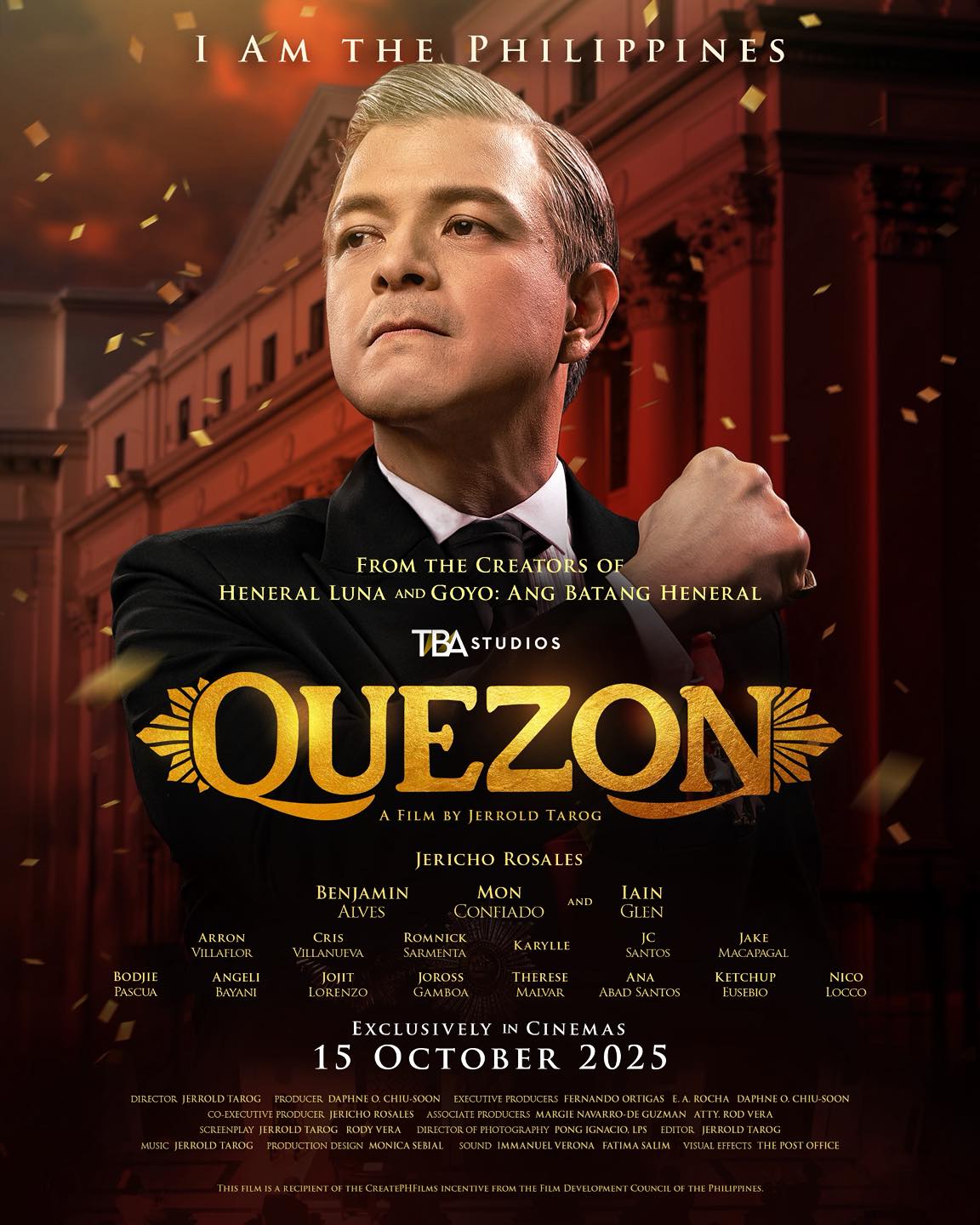
SOON, Jerrold Tarog’s “Quezon” will come out in the cinemas, the third installment in the ‘bayaniverse’ of TBA Studios. Since the first film, “Heneral Luna” in 2015 and “Goyo: Ang Batang Heneral” in 2018, Dakila, a collective promoting Filipino heroism, has been tapped to conduct a nationwide tour to promote the films under the project “Bayani Ba ‘To” (which alludes to heroes as monuments but also to a question about their heroism), where historians like John Ray Ramos, Alvin Campomanes, Natasha Kintanar and myself lead the discussions. The warts-and-all approach of the films makes them more appealing than the almost hagiographic approach to the teaching of heroism.

Last June 23, 2025, the historians, Dakila and a representative of TBA met to consolidate our insights on how to contextualize “Quezon” (without spoilers).

Answering the question, “Was President Manuel Quezon a bayani?” is more complicated than perhaps asking, “What was his contribution to Philippine history and to us Filipinos?” Arguably, Quezon is the “Architect of the Modern Philippine State.” And he was able to do it because, as a pioneer actual national leader of the country, he assumed a cultural role familiar to the people, a “datu,” whose role in indigenous society is to distribute “karangalan” (honor) and “kaginhawaan” (well-being) and was also the chief bagani (warrior). When the Spanish colonizers came, the datu class became the principalia class, who became the bridge between the people and the colonial masters. The survival of the system rests on negotiating with the colonizer in order to continue governing and providing for the people. This continued when certain elites were given favor by the American imperialists.

Add to this mix, according to fellow Manila Times columnist Van Ybiernas, the fact that a whole generation of potential heroic leaders was wiped out during the Philippine Revolution, like José Rizal, Andres Bonifacio, Marcelo H. del Pilar, Emilio Jacinto, etc. Those who remained in the same patriotic spirit when the Americans came, like Macario Sakay, were wiped out too. That nationalist route would lead to death. And so, Quezon’s generation figured that they should creatively show nationalism in front of the people while patronizing the Americans for survival.

This is the reason why Quezon was described as “janus-faced”: He said one thing to the people, and another to the elite and the imperialists. And since the Americans were the only colonial power to promise independence to their subjects as the Jones Law was passed, nationalism and loyalty to America had no contradiction. This is how Quezon helped create a nation in the face of American imperialism: He had to have transactional relations with the elite and the Americans so he could provide for his people. In his imaging (“papogi”), he created a cult of personality, the heroic datu who facilitates “kaginhawaan,” which is the basis of the patronage politics in our present society.

So yes, there were the two sides of Quezon. The one who told his daughter Zeneida, or Nini, “Never forget the poor.” He was the visionary who put forward “social justice” as the banner cry of his leadership, that there should be a preferential option for the poor. He was radical in his empathy and inclusivity in allowing the women’s vote and the adoption of a national language. He demonstrated the Filipinos’ “kapwa” culture by implementing the eight-hour day and minimum wage, housing projects, and championed human rights by not implementing the death penalty, believing that no Filipino should beg for his life in his administration, and by rescuing 1,300 Jews from the Holocaust.

But he also institutionalized a traditional, patriarchal, transactional populist system which continued colonial dependency and elite democracy. This is Quezon’s contradictory legacy for good (and for bad). I guess we should give credit to where credit is due but also learn from his faults.

His batchmate, Emilio Jacinto, wrote, “Let us seek the light and do not let us be deceived by the false glitter of the wicked.” So, I will leave it to you to answer if Quezon was indeed a bayani. But I would like to end with a quote which Quezon was heard to have said toward the end of his life in reference, I believe, to Sergio Osmeña, his vice president: “Look at that man, why did God give him such a body when I am here struggling for my life? I am Manuel L. Quezon — I am the Filipino people, I am the Philippines.”

Truly, he once represented the Philippines, but now we always mistake loyalty to the leader as loyalty to the country and criticizing the leader as being disloyal to the nation. We have always depended on leaders and strongmen as our heroes. We always ask the question “Bayani ba ‘to?” But the hero we are looking for might be the image in front of us when we look at the mirror: “I am the Philippines, tayo ang Pilipinas, tayo ang bayan, tayo dapat ang bayani.”

“Pero bayani ba talaga tayo?” Let this be both a call for action and an aspiration. We are the Philippines. We have the power to change our country.

Perspective Check (for The Fookien Times Philippines Yearbook)

What is the way forward for historians and public history in today’s increasingly polarized climate?  Michael Charleston “Xiao” Chua explores the question and revisits the role of history in our national life.

Xiao Chua, by Greg Mayo

When talking about history as a public historian, some say I should be totally objective and be non-political.  But can it be divorced from politics?  Aristotle himself said, “man is a political animal” and that “every man, by nature, has an impulse toward a partnership with others,” Historian Teodoro Agoncillo echoed the sentiment, saying, “No true historian can disengage himself from the object of his study, for he is too much of a human being to repel his own nature.”

While some people who believe historical discourse should be confined to the academe to remain scholarly, even before academia was invented or introduced in this country, historical discourse had always been “public.” 

If we take into account historian Zeus A. Salazar’s analysis of our native word for “history,” i.e. “kasaysayan”—the root word “saysay” translates to both story and relevance—we can say that the precursor of historical discourse came from the epics and myths chanted by the babaylanes, local religious leaders, healers and storytellers; and the binukots or the community maidens.  Their stories united the community; the oral traditions, while not always factual, reflected their real beliefs, characteristics, and aspirations.  When the “bayan” or the community listened to stories of the past, they would feel that they were one people, sharing the same past and future, journeying the same boat.

That is why the orality of “chismis,” where writing was only prevalent to our ancestral elites, can actually be part of historical analysis, not as a measure of factuality of events, but of mentalities of those who shared the oral stories.

When the Spanish colonizers came, they showed us a bipartite view of history in their chronicles.  There they described our lives before the conquista as dark, uncivilized, and without progress, with them introducing us to the “maravillosa civilizacion christiana” (Wonderful Christian Civilization).  Despite our dynamic culture syncretising with Catholic culture, we came to depend on Spain as the giver of enlightenment, which helped subjugate us.

The Spanish writer José Felipe del Pan urged Filipinos to write history in their own perspective.  Father José Burgos, Pedro Paterno, Isabelo de los Reyes and eventually José Rizal, T. H. Pardo de Tavera and many others will make studies on our ancestors and develop what Zeus Salazar would call the legacy of the Propaganda Movement—“the Tripartite View of History.”  That is:  before colonialism, our ancestors were progressive and had an elaborate civilization, and then colonialism came and there was darkness.  They used history to campaign to Spaniards for the third part of history:  A life of “kaginhawahan” because the colonizers reformed Las Filipinas.

Although La Propaganda politically failed, its writings gave a sense of oneness and nationhood to the Filipino reading elite.  But Andres Bonifacio, the Father of the Filipino Nation, will appropriate the tripartite view of history and write in his people’s language in the 1890s to urge his compatriots to fight and die to give birth to the aspired nation in “Ang Dapat Mabatid ng mga Tagalog.”  The national sentiment was fostered among many, such that thousands of Filipinos rose in 1896 to fight for independence during the Philippine Revolution and established their own national governments, the Haring Bayang Katagalugan headed by Bonifacio as President, an indigenous concept of nation that goes back to our Austronesian maritime historical roots (taga-ilog), and subsequently, the first constitutional democratic republic in this continent, the Republica Filipina headed by Emilio Aguinaldo, established in 1899.

When the Americans came, their sentimental imperialism wanted them to be the best imperialists, to win the hearts and minds of the Filipinos.  They hired researchers, headed by Emma Helen Blair and James Alexander Robertson,  who translated all available Spanish documents showing our history before and during colonialism and they came up with a 55-volume work The Philippine Islands 1493-1898 (also known as the Blair and Robertson).  Boy, oh boy, the Americans knew our soft spots.  Despite the bloody Philippine-American War, the way they framed the public school system as their heritage despite giving us a colonial education, made us look favorably towards them to this day. 

After the revolution and on the onset of the 20th century, the careers of politicians and former revolutionary leaders were at stake as they invoke the names and images of national heroes, battling the spotlight in newspapers about their version of history.  Manuel Quezon, Jose P. Laurel, among others, used it to rally people in their campaign for independence.

After the Second World War, veterans and many Filipinos used the commemorations of that war to remind the US of how we fought together as partners and ask for rightful reparations and compensation.  On the other hand, nationalist politicians like Claro M. Recto, and subsequently nationalist historians Teodoro Agoncillo and Renato Constantino would use history to remind us of American neo-colonialism that continued even after independence.  This kind of historiography will even be used by rebels and revolutionaries as Amado Guerrero (José Ma. Sison) in his book Philippine Society and Revolution, to remind people to take the cause of the oppressed.

Strongman Ferdinand E. Marcos knew the power of history and culture, using it to justify his 20-year rule, from proliferating the ancient myth of the “Malakas and Maganda” (reincarnated to Ferdinand and wife Imelda) and the Ilocano folk hero Lam-ang (in the epic reincarnated by a person named Marcos), to commissioning historians to write a multi-volume work titled Tadhana:  The Story of the Filipino People under his by-line and authorship (notably still the best work on the 16th to 18th century Philippines).  Marcos also rekindled the ancient barangay leadership and shaped himself to become the modern datu, or even, the modern Kalantiyaw (although eventually this ancient lawgiver was exposed to come from a hoax).

The memory of the people’s revolution of 1986, also known as EDSA People Power, was invoked by many of its participants to advance their political gain.  Many human rights advocates also used it to advance consciousness on the importance of democratic rights.  This time of soul searching also strengthened the movement to indigenize Philippine History in the academe such as the Pantayong Pananaw by its adherents headed by Zeus A. Salazar, as the nation moved forward to its 100th birthday in 1998.  Such commemorations paved the way for an explosion of public history in the media, including the television show Bayani.

The election of Noynoy Aquino in s2010 rekindling the memory of People Power was expected to institutionalize this perspective of history, yet the guy had much delicadeza.  Except in official commemorations, the PNoy team avoided making self-serving histories using the people’s money.  Manolo Quezon’s team in the Presidential Communications Office, instead of edifying the people power narrative, went back to the basics and sorted out our political history by digitizing and putting out Philippine institutional papers and photographs for the people to have a basic official history in the Official Gazette.  From 2012 to 2017, the government station PTV4 also launched the TV segment Xiao Time

Beginning in 2011, a deliberate attempt to attack the People Power narrative and restore the luster of the Marcos name seemed underway in social media.  By strategically aligning themselves to the popular Rodrigo Duterte, the pro-Marcos propaganda machine touched on the fears, frustrations and aspirations of the people and used sensational language to sow division in the nation and galvanized those frustrated with the democratic institutions.  This paved the way to the election of Ferdinand “Bongbong” Romualdez Marcos, Jr. as president.

What is the way forward for historians and public history in such a climate?  Agoncillo also wrote that, “though history is not objective, it must nevertheless be impartial. Impartiality implies the moral responsibility of a historian to weigh the pieces of evidence and to derive just conclusions therefrom.”  One can have a political stand but can also be fair.  Perspectives and judgments are a must in studying history but methodology and fairness lessen biases.

History has always been a battlefield; we cannot undo that.  But to borrow Canadian historian Margaret MacMilan’s words, we should always be aware of the “uses and abuses of history.”

We will further polarize the nation if we will be too intolerant.  We must allow many perspectives, yet we should uphold the importance of evidence.  Because, as we can see with the ancient babaylan, the role of history and of the storyteller is to edify and unify the nation with stories that inspire them to be better Fiipinos.  History can be used to enslave us with rage, but we aspire for a history that inspires, liberates and empowers the people.

In a time when some wants us to forget, it is courageous to remember and remind people that history should be the story of liberty.

               25 July 2022

My thanks to guest editor Manuel Quezon III and Ditas Bermudes for the trust. Please read context: https://www.facebook.com/sirxiaochua/posts/pfbid0jZRMg2RdjKLH9BGtnP2hg5NoTAJVVELeHK1XzEiwrGjh9vZ4hEE6TESzdyUnwBhWl

Bayanihan and order in the Black Nazarene procession

The Manila Times, Walking History Column

January 13, 2018

MICHAEL “XIAO” CHUA

ORDER and bayanihan are words that people will not easily associate with the Black Nazarene “Traslación” held every January 9 in Manila.

“Traslación” is the Spanish word for transfer. The procession of the Señor from Luneta’s Quirino Grandstand back to Quiapo commemorates how the original Mexican image of the suffering Lord carrying His cross, which was once housed at what used to be the Church of St. John the Baptist at the Luneta, was transferred after some time to the Recoletos Church in Intramuros (this original burned during World War 2). A replica of this original was made and was “handed over” to the present church in Quiapo during the time of Archbishop Basilio de Santa Justa y Rufina in 1767 or 1787 depending on what article you are reading.

It must be clarified that although the procession of the Black Nazarene around Quiapo is already a 200-year or so tradition, the “Traslación” itself is a recent invention that only started in 2007 to commemorate the 400 years of the coming of the Recollect priests who introduced the image, and then again in 2009, after which it had become an annual event.

Contrary to popular legend that the Nazarene is black because it survived a fire, a kind of dark wood was used to carve it. Its color made it even more attractive because in this representation the Lord looks like us, who suffered the humiliation of crucifixion as we also suffered the yoke of colonialism. But each of us know that this is not the end of the story. Just as the Lord was resurrected after three days, we too will find an end to suffering towards healing and redemption.

Television footage seems to show us hundreds of thousands of fanatical devotees at one time scrambling to get near the “andas” of the señor. They wanted to have their hankies be touched to the image to acquire power and healing as our ancestors did to their anitos. Some people noticed how selfish some devotees are as they stepped on others just to get near the image. Devotees are quickly judged as illogical, chaotic and crazy.

But Msgr. José Clemente Ignacio, the former Rector of Quiapo Church who developed the “Traslación” as we know it today, said that “to understand the devotion, one must be a devotee.”

Victor Turner described in his articulation of the ritual process that devotees at a certain stage of devotion enter liminality—a phenomenon that takes us away from our daily lives where the notion of time, class and divisions are suspended. In this, we re-enact the crisis and struggles that brought us together in the faith. In the Black Nazarene Traslación, everyone around the andas seems to be in a trance in a semblance of unity and equality where everyone is barefoot. Communitas is achieved.

As a visual people with a penchant for drama and soap opera, the procession of the Black Nazarene has become a way for Filipinos to visually dramatize their faith. Crowd management expert Martin Aguda dubbed the procession a “simulated choreographed craze.” Seeming chaos that is created by the calculated and collective action of the people.

Certain hand signs are used by the hijos to direct the devotees in pushing the andas forward. There is a “coda” that devotees understand. The word “salya” is shouted and devotees run together and use the force of their bodies to slam the andas to move forward or to put it into order. Also, the people around the andas allowed themselves to be stepped upon as a form of penitence as they help others climb as well. And despite hundreds of thousands of “namamasans” wanting to climb the andas, there are on average less than 500 injuries annually, and for many years, zero procession-related deaths. Because there actually exists a system—a certain way of going to the throng or going under the rope to avoid being injured and to avoid injuring others, putting your two hands in front of your chest area. A certain way to go with the flow of the crowd which are like waves in a river reminiscent of the fluvial processions in this maritime nation. A way of calling for help by raising one’s hand if one wants to be removed from the throng. They will be swiftly raised up by their fellow devotees to safety. A way for a hankie that is thrown to a member of the hijos to return to the person who owns it after being wiped on the image.

With this we see that the concept of “salya” and the whole procession itself encapsulate both our concepts of order and bayanihan. If we put it on a macro level, the whole traslacion itself is a phenomenon that is animated by the people, the church and the government, “sinasalya ng buong bayan,” to its intended orderly and safe conclusion.

Saan nagmula ang salitang Undas?

By XIAO CHUA

First published by GMA News, November 1, 2015 10:20am

Dahil panahon na naman ng Todos Los Santos at pupunta na naman tayo sa sementeryo upang alalahanin ang ating mga mahal sa buhay, balikan natin ang mga tradisyon ng ating mga ninuno na may kinalaman sa mga yumao. 

Dahil sa impluwensyang Katoliko ng mga Espanyol, naitali sa Todos Los Santos o All Saints’ Day ang paggalang natin sa mahal nating mga kaanak na yumao at tila ang ating mga namatay na ninuno ay itinuturing na rin natin na mga santo na nasa langit kasama ng Panginoon.  

Ang doktrina ng Santa Iglesia Catolica Romana ay nagsasabi na ang namatay na mahal sa buhay ay ipinapanalangin upang mahango sa purgatoryo, mapunta sa langit o magabayan ang kanilang mga kaluluwa sa kabilang buhay.  

Panahon ng Sinaunang Bayan

Ngunit hindi ba kayo nagtataka, kapag undas ay hindi lamang natin ipinapanalangin ang mga patay, nagdadasal tayo mismo sa kamag-anak natin at kinakausap natin sila?  Ito ay pagpapatuloy ng sinaunang kulturang Pilipino na mas matanda pa sa Katolisismo sa Pilipinas.  

Pagdating ng panahon, kapag tayong lahat ay wala na dito sa mundong ibabaw, libu-libong taon ang lilipas, ang mga tao sa hinaharap ay mahuhukay ang ating mga libingan.  At sa mga libingan na ito makikita nila kung paano tayo mamuhay.  Tulad ng ginagawa ng ating mga arkeyologo ngayon, hinuhukay nila ang mga libingan ng ating mga ninuno at nagkakaroon sila ng ideya sa kung ano ba ang pamumuhay ng mga tao noon batay sa anyo ng paglilibing at sa mga gamit na isinasama sa mga bangkay.  

Noong unang panahon ng mga ninuno nating Austronesians, naglilibing ang mga Pilipino sa mga banga.  Iba-iba ang klase nito.  May isang natagpuan na hugis itlog na banga na inilibing sa lupa.  Makikita na sa bangang ito, buong tao ang inililibing.  Ang tawag dito ay Primary Burial Jar.  Sa ibabaw ng libingan ay may mga bato na ihinugis sa bangka.  Salamin ito ng halaga sa ating mga ninuno mula Luzon hanggang Mindanao ng kultura sa paglalayag o Maritime Culture ng mga Pilipino, at naniniwala silang sa pamamagitan ng katubigan at bangka dinadala ang mga kaluluwa sa kabilang buhay.  

Sa mga kapatid nating Badjao sa Sulu, ang kanilang mga pananda sa mga libingan na tinatawag na sunduk ay disenyo ng bangka na may nakatayong tao.  

Tila kahalintulad din ito ng pinakamahalagang libingang banga sa Pilipinas na natagpuan sa Kuweba ng Manunggul sa Palawan, ang Manunggul Jar na ang edad ay tinataya nilikha noong 710 B.C.  Ang disenyo ng takip ay tila mga alon sa dagat at sa ibabaw nito, dalawang kaluluwa na nakasakay sa isang Bangka-kaluluwa na may mukha.  Mga buto na lamang ang inilalagay dito kaya maituturing ito na Secondary Burial Jar.  Noong 1991, daang-daang secondary burial jars ang natagpuan sa Ayub Cave sa Maitum, Saranggani.  Ang mga takip ay pinaniniwalaang representasyon ng nakalibing, disenyo ng iba’t ibang mukha.  

Tulad nang makikita sa bangang panlibing na Manunggul, naniwala ang mga ninuno natin na ang ating mga kaluluwa kapag tayo ay namatay ay naglalakbay at dumadaan sa mga ilog at dagat patungo sa kabilang buhay bilang salamin ng ating maritime culture.  Sa Batanes, may mga natagpuang mga libingan sa lupa ngunit ang kanilang mga pananda ay mga batong hugis Bangka, at sa Cordillera na kahit bulubundukin, ang mga kabaong kung saan sila naglilibing sa mga kweba ay hugis bangka rin!  

Ang mga kaluluwa ng mga namatay ay itinuturing na anito na nagbabalik sa kalikasan, sa mga ilog, sa mga bundok, sa mga bato at sa mga punongkahoy.  Sila ay kinakatawan ng mga estatuwa at inaalayan at dinadasalan natin ang mga ninuno natin na ito.  At pinaniniwalaan na nakikipag-usap pa ang mga anito sa atin noon sa pamamagitan ng mga babaylan at catalonan.  

Kaya hanggang sa ngayon ipinagpapatuloy natin ang pakikipag-usap sa mga namayapa.

Pinag-aralan naman ni Dr. Grace Barretto-Tesoro sa kanyang disertasyon sa Cambridge ang mga libingan ng mga ninuno natin sa Calatagan, Batangas kung saan natagpuan ang mga ninuno natin na nakalibing kasama ang mga shells na Tridacna gigas, ang iba ay may mga ginto at alahas, at ang iba may mga ibang bungo na nakalibing.  Ang bangkay na ito ay pinaniniwalaan na sa isang Catalonan, ang babaylan o espituwal na pinuno sa Luzon.  

Bayan sa Panahon ng Kolonyalismo

Ang pista ng patay sa Pilipinas ay tinatawag nating “Undas.”  Nang tanungin ko si Dr. Lars Raymund Ubaldo, ang salitang “Undas” ay nagmula sa Espanyol na “honras funebres” o funeral honors na sa ibang lalawigang Tagalog ay naging “honras” at “undras,” at sa Ilocos ay “atang” na tinatawag ding “umras.”

Pinag-aralan ni Dr. Ubaldo ang kaugalian sa Ilocos ng pagtagis sa burol na ang inaawit ay ang buhay ng namatay.  Tawag dito sa tagulaylay na ito ay dung-aw.  Tila pagpapatuloy ito ng sinaunang pag-awit ng epiko ng mga ninuno natin.

Noong unang mga taon ng ika-20 siglo, ayon sa Kapampangang si Alex R. Castro, ang pagpapalibing ay P 30.00 na samantalang ang mananahi ay sumasahod ng P5.00 lamang kada buwan.  

Kung ikaw ay Katoliko, nararapat ka lamang ilibing sa Sementeryong Katoliko.  Ang mga ito ay itinuturing din na banal na lugar kaya tinawag itong Campo Santo—banal ang mga inililibing dito.  Kadalasan sa mga sementeryo na ito ay mayroon isang ermita, o isang maliit na simbahan tulad ng nabisita ko sa Paniqui, Tarlac; Vigan, Ilocos Sur; at sa San Joaquin, Iloilo.  Isa sa pinakasikat na Sementeryong Katoliko sa bansa ay ang Sementeryo ng Nagcarlan. Dahil ito ay nasa mataas na lugar, tila mayroon itong basement kaya tinawag itong Underground Cemetery.  Sa mga tagong lugar na ito lihim na nagpulong ang Katipunan sa Laguna noong Himagsikang 1896.  Ang mga hindi Katoliko ay inililibing sa Sementeryo halimbawa ng mga Tsino.  

Ang mga tao rin noon ay kumukuha ng Recuerdos de Patay o “Souvenirs of the Dead,” tulad ng obra na ito ni Simon Flores ng isang patay na bata na ipinagpatuloy naman sa pagpapalitrato kasama ang patay.  Kung minsan itinatayo pa ang kabaong para makita ang patay sa loob.  

Ayon kay Ambeth R. Ocampo, ang peryodikong Renacimineto Filipino ay napakahilig na ilabas ang litrato ng kamatayan ng mga bayani.  Ito si Miguel Malvar matapos malagutan ng hininga noong 1911, full coverage ang kanyang libing.  Nilathala din ang larawan ng ina ni Rizal “en enfermedad” o sa kanyang pagkaksakit, at “el cadaver” bilang isang bangkay!  

Ang Kahulugan ng D.O.M. sa mga Puntod

Sa mga semeteryo, makikita rin sa disenyo ng mga puntod ang kalagayan ng tao.  Isang obra ni Guillermo Tolentino ay nakalagay dati sa isang puntod ng isang mayaman sa Bulacan na ngayon ay nasa Pambansang Tipunan ng Sining sa Pambansang Museo ay isang malaking rebulto ng anghel na katulad ng anghel sa taas ng Monumento ni Bonifacio sa Caloocan, ngunit ito ay tila nakabuka ang palad na nagsusumamo sa Diyos na tanggapin ang kaluluwa ng yumao.  

Nagsimula tayong maglibing sa mga kabaong na may mga panandang krus o mga lapida noong panahon ng mga Espanyol.  Kung maykaya ka, maaari kang mailibing sa loob ng Simbahan tulad nitong mga pamilyang Roxas, Zobel at Ayala na mayroong sariling kapilya sa Simbahan ng San Agustin sa Intramuros.  

Sa pagtingin sa mga lumang simbahan sa Pilipinas makikita mo ang mga nakasulat sa lapida tulad ng  “Recuerdo de la Familia”—katumbas ngayon ng nakalagay na “Family Remembrance.”  Liban sa R.I.P. (Hindi pa Ingles noon na Rest in Peace kundi Latin na “Requiescat in pace”) at D.E.P. para sa Espanyol na “Descansar en Paz,” mayroon ding D.O.M.  Akala ng iba, Dirty Old Man ito, pero nagmula pa pala ito sa mga paganong Romano na nagsasabi na Deo, Optimo Maximo, “To the Greatest and Best God,” pinauubaya na ang mahal sa buhay sa kandungan ng makapangyarihang Diyos.  Kung mahirap ka sa Katagalugan, hindi Latin o Spanish ang mga letra na nakalagay sa lapida mo kung hindi S.L.N.—hindi yan “Sa Lagnat Namatay” ha kundi “Suma Langit Nawa.”  

Ang mga libingan ay hindi lamang himlayan o lugar na katatakutan, ito ay isang mayaman na batis ng ating kasaysayan.  

Ang Halloween at ang Pagpasok ng Komersyalismo sa Undas 

Tulad ng maraming aspekto ng kultura, ang Undas ay ginawang negosyo sa pagdating ng impluwensyang Amerikano sa Pilipinas sa pagpapakilala nila ng konsepto ng Halloween.

Ipinagdiriwang sa daigdig ang Halloween tuwing October 31.  Ang salitang ito ay nagmula salitang “All Hallow’s Evening,” ang kahulugan ng “hallow” ay saint dahil gabing bisperas nga ito ng All Saints’ Day.  

Kasabay nito ang bisperas ng pista ng mga patay na ipinagdiriwang pa ng mga sinaunang Celtic bilang “Samhain” kung kalian pinaniniwalaan nilang bumabalik sa mga tahanan nila ang kaluluwa ng mga ninuno nila.  Ginugunita nila ito sa pamamagitan ng “trick or treat,” kumbaga, kung may kakatok sa iyo at hindi mo bigyan ng kahit ano ay maaari ka nilang lokohin ng mga pranks.  Upang kumatawan sa mga kaluluwa na maaari kang saktan o patayin kung maging maramot ka, nagsusuot ng kung anu-nong nakatatakot na costume ang mga bata.  

Gayundin, gumagawa ng mga inukitang kalabasa o pumpkin ang mga Kanluranin upang pantaboy sa mga masasamang demonyo na naglipana sa tuwing Holloween.  1866 unang nabanggit ang koneksyon ng Holloween at pumpkin sa Amerika.  Mapapansin din na sa kwentong bayan sa Kanluran, ang mga mangkukulam ay may nakaugalian na gawing mga pumpkin ang mga tao.  Dahil sa komersyalisasyon at globalisasyon, umabot ang mga Kanluraning praktis na ito sa Pilipinas.  Kung anu-anong kasuotan at mga dekorasyon ang nabibili ukol dito at kung anu-anong party at reunion ang nagaganap sa panahong ito.  Ang dung-aw ay napalitaan na ng videoke.  Tila nagsanib ang komeryalismo ng kanluran at ang pagiging masaya at pagbubuklod ng mga Pilipino na makikita kahit sa mga lamay.

Ngunit sa kabila nito, sana hindi natin malimutan ang dahilan ng undas, ang pag-alala sa ating mahal sa buhay, na panatilihin sila sa ating puso kahit sila ay wala na.  

Mabalik tayo sa undas.  Ang lumang terminong Kapampangan sa pag-aalay ng mga bulaklak sa mga patay ay “Daun.”  Parang binaligtad lang na Unda.  

Muli, ngayon alam niyo na ang UNDAS ay nagmula sa Honras Funebres, hindi sa binaligtad na “SADNU?”  Dahil hindi naman sad ang pista ng patay sa Pilipinas, hindi ba HAPPYNU ito?  

Happy Undas!  

_______________________________________________________________________________

Si Prop. Michael Charleston “Xiao” Briones Chua ay kasalukuyang assistant professorial lecturer ng Pamantasang De La Salle Maynila.    Isa siyang historyador at naging consultant ng GMA News TV series na Katipunan at Ilustrado.    Ang sanaysay na ito ay batay sa kanyang news segment sa “Xiao Time:    Ako ay Pilipino” sa istasyong pantelebisyon ng pamahalaan.  

Retraction ni Jose Rizal: Mga bagong dokumento at pananaw

By XIAO CHUA

First published in GMA News, December 29, 2016 7:05pm

There seems to be no end to the debate whether Rizal retracted his writings against the Catholic Church on the very last day of his life. Will a new independent testimony settle the debate finally?

Ayon sa ilan, si Jose Rizal, na pinaslang ng mga kolonyalistang Espanyol 120 years ago, December 30, 1896, ay naging bayani dahil sa kanyang mga sinulat upang wasakin ang ideya ng kolonyalismo at palayain ang isip natin upang mabuo ang bansa—ang Noli Me Tangere at El Filibusterismo at ang kanyang mga sanaysay sa La Solidaridad, na kumuwestiyon sa mga paniniwalang nakabubulag sa atin, lalo na ang pagsunod sa kagustuhan ng mga prayle bilang sugo ng Diyos.

Ngunit, ilang oras bago siya barilin, pinirmahan daw ni Rizal ang isang dokumento na nagsasabing siya raw ay isang Katoliko at binabawi niya lahat ng kanyang mga sinulat laban sa simbahan. Nakilala ang dokumento bilang ang retraktasyon, “The Retraction.” Dahil sa kanyang pagbabalik-loob sa simbahan, ikinasal sila ni Josephine Bracken, ang kanyang huling pag-ibig.

http://images.gmanews.tv/webpics/2016/12/Ang_sinasabing_Retraktasyon_ni_Rizal_(Courtesy_of_Ambeth_R_Ocampo)_2016_12_29_17_16_23.jpg

Ang sinasabing retraktasyon ni Rizal. Courtesy Ambeth R. Ocampo

http://images.gmanews.tv/webpics/2016/12/Salin_ng_Dokumento_ng_Retraktasyon_2016_12_29_17_20_46.jpg

Salin ng dokumento ng retraktasyon

Ayon sa ilan, mas lalong naging dakila si Rizal sa pagkilala ng kanyang mga kamalian laban sa pananampalataya. Ngunit para naman sa marami, hindi kapanipaniwala na sa huling sandali ng kanyang buhay, babawiin niya ang kanyang mga sinulat, ang dahilan ng kanya mismong pagkabayani. Para na rin niyang itinapon ang kanyang kabayanihan.

  • Ang testimonya ni Padre Vicente Balaguer

Kahit natagpuan ang sinasabing dokumento ng retraktasyon noong 1935, patuloy ang pagdududa. Lalo na sa itinuturing na natatanging eyewitness account ng pangyayari—ang isinulat ng Heswitang si Padre Vicente Balaguer. Paano naman kasi, ang resonableng si Rizal ay bigla na lamang nagising ng makailang beses, apat na beses na nangumpisal, nagpamisa, nangomunyon at nagrosaryo pa. Kakatwa para sa ilan, kabilang na ako.

Isa ako sa mga historyador na hindi naniniwala sa retraktasyon. At para sa akin, hindi na matatapos ang “Retraction Controversy.”

Isa lamang ang maaaring magresolba nito, sabi ko—kung magkakaroon ng isa pang eyewitness account ng gabi at umagang iyon na maaaring magpatunay o magpasinungaling sa retraktasyon o sa testimonya ni Padre Balaguer.

  • Ang testimonya ng Cuerpo de Vigilancia

Nitong 4 August 2016, binasa ni Commissioner Rene R. Escalante, ang OIC ng National Historical Commission of the Philippines, ang isang “Professorial Chair Lecture sa Rizal Studies” na pinamagatang “Re-examining the Last 24 Hours of Rizal Using Spy Reports” sa De La Salle University.

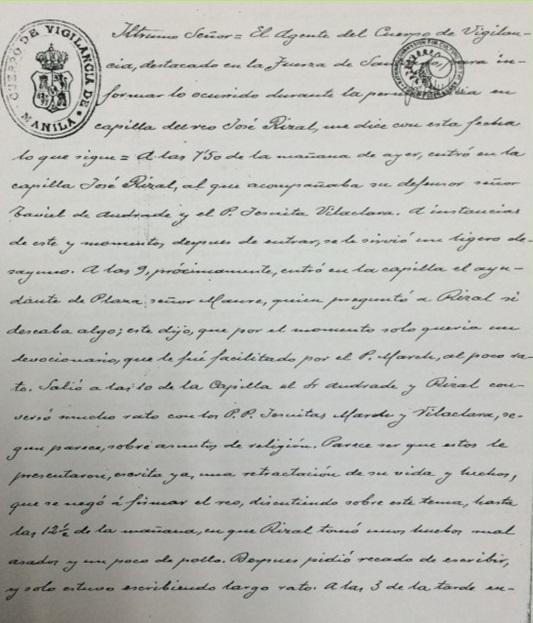
Sa mga dokumento ng mga espiyang Espanyol na tinatawag na Cuerpo de Vigilancia, matatagpuan ang ulat na isinulat sa araw ng kamatayan ni Rizal ni Federico Moreno, na nagkukuwento ng pahayag sa kanya ng isang ahente ng Cuerpo de Vigilancia, isang bantay sa selda ng Rizal, samakatuwid, isang “additional independent eyewitness account.”

http://images.gmanews.tv/webpics/2016/12/Ang_Unang_Pahina_ng_Report_ni_Federico_Moreno_(Cuerpo_de_Vigilancia,_NCCA)_2016_12_29_17_16_46.jpg

Ang unang pahina ng ulat ni Federico Moreno (Cuerpo de Vigilancia). Courtesy National Commission for Culture and the Arts

Ayon sa pahayag, sumulat si Rizal ng isang papel na narinig niyang ang retraktasyon. Binanggit rin ang dalawang paring Heswita na pumasok sa piitan ni Rizal—si Padre Jose Vilaclara at Padre Estanislao March, at dalawa pang tao, sina Juan del Fresno at Eloy Moure. Narito ang ilang bahagi ng sanaysay na isinalin na sa Ingles mula sa wikang Espanyol:

“Most Illustrious Sir, the agent of the Cuerpo de Vigilancia stationed in Fort Santiago to report on the events during the [illegible] day in prison of the accused Jose Rizal, informs me on this date of the following:

“At 7:50 yesterday morning, Jose Rizal entered death row accompanied by his counsel, Señor Taviel de Andrade, and the Jesuit priest Vilaclara. At the urgings of the former and moments after entering, he was served a light breakfast. At approximately 9, the Assistant of the Plaza, Señor Maure, asked Rizal if he wanted anything. He replied that at the moment he only wanted a prayer book which was brought to him shortly by Father March.

“Señor Andrade left death row at 10 and Rizal spoke for a long while with the Jesuit fathers, March and Vilaclara, regarding religious matters, it seems. It appears that these two presented him with a prepared retraction on his life and deeds that he refused to sign. They argued about the matter until 12:30 when Rizal ate some poached egg and a little chicken. Afterwards he asked to leave to write and wrote for a long time by himself.

“At 3 in the afternoon, Father March entered the chapel and Rizal handed him what he had written. Immediately the chief of the firing squad, Señor del Fresno and the Assistant of the Plaza, Señor Maure, were informed. They entered death row and together with Rizal signed the document that the accused had written. It seems this was the retraction.

Makikita na ang dalawang binanggit na opisyal, sina Juan del Fresno at Eloy Moure, ay ang mga nakapirma mismo sa dokumento ng retraktasyon na tumayong mga saksi. Gayundin binanggit ng guwardiya na bago dalhin sa Luneta si Rizal, ikinasal siya kay Josephine Bracken:

“At 5 this morning of the 30th, the lover of Rizal arrived at the prison …dressed in mourning. Only the former entered the chapel, followed by a military chaplain whose name I cannot ascertain. Donning his formal clothes and aided by a soldier of the artillery, the nuptials of Rizal and the woman who had been his lover were performed at the point of death (in articulo mortis). After embracing him she left, flooded with tears.”

At ang nakagugulat, itinala ni Moreno, ang lahat ng taong pumasok sa selda noong gabing iyon, ni minsan, walang binanggit na may pumasok na Padre Balaguer. Ibig sabihin wala si Padre Balaguer doon, maaaring secondary source na lamang siya at kinapanayam lamang sina Padre Vilaclara at Padre March upang buuin ang kanyang testimonya.

Mayroon akong malaking paniniwala na walang dahilan para magsinungaling ang guwardiya o si Moreno lalo na at ginawa nila ang tala sa mismong panahon na iyon.

  • Ang sinulat ni Rizal sa kopya ng “Imitations of Christ”

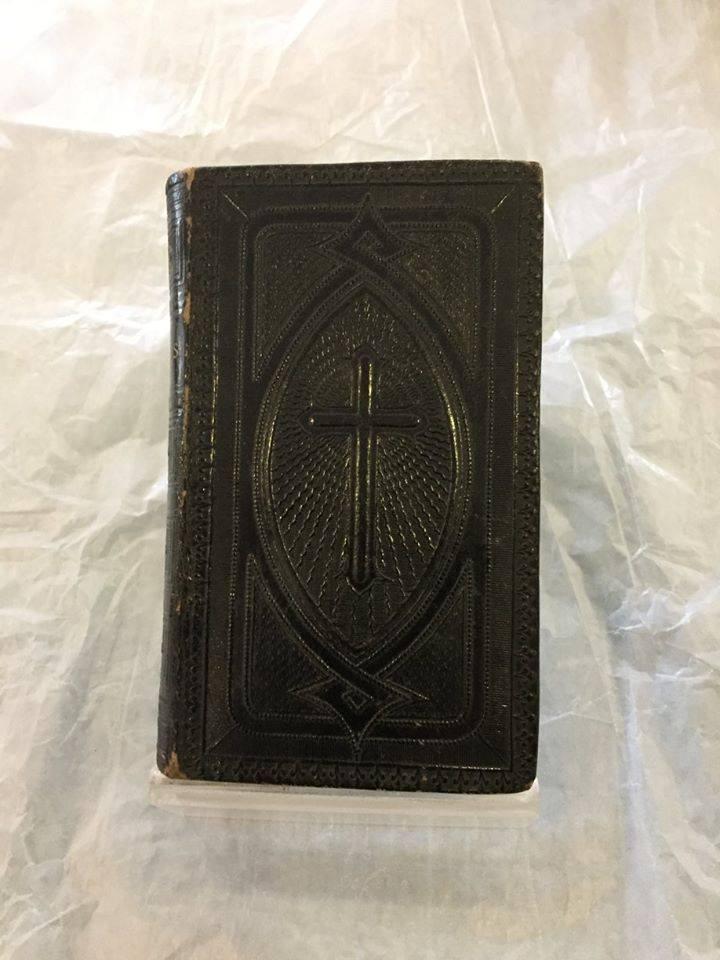
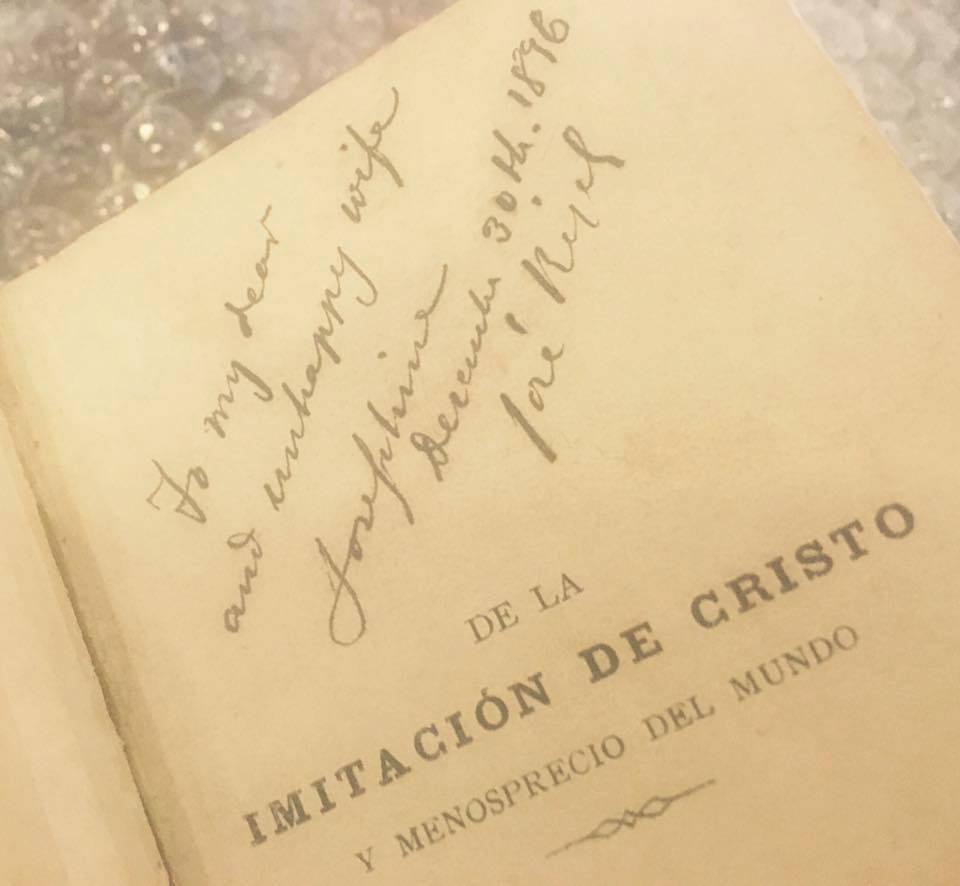
Kamakailan, isang kopya ng “De La Imitacion de Cristo” na isinulat ni Thomas á Kempis ang ipinaubaya sa Direktor ng Pambansang Museo ng Pilipinas, Jeremy Barns. Ito ang mismong kopya na ibinigay ni Rizal kay Josephine Bracken sa kanyang huling pagbisita dito sa araw ng kanyang kamatayan. Isinulat niya dito, “To my dear and unhappy wife, Josephine, December 30th, 1896, Jose Rizal.”

http://images.gmanews.tv/webpics/2016/12/Kopya_ng_De_La_Imitacion_de_Cristo_(Courtesy_of_Jeremy_Barns)_2016_12_29_17_17_16.jpg

Kopya ng ‘De La Imitacion de Cristo.’ Courtesy Jeremy Barns

http://images.gmanews.tv/webpics/2016/12/Kopya_ng_De_La_Imitacion_de_Cristo_na_may_sulat_ni_Rizal_(Courtesy_of_Jeremy_Barns)_2016_12_29_17_17_37.jpg

Kopya ng ‘De La Imitacion de Cristo’ na may sulat ni Rizal. Courtesy Jeremy Barns

Liban sa tinawag niyang “wife” o asawa dito si Josephine, na maaaring magpatungkol sa pagiging legal ng kanilang kasal, ang mismong aklat na ibinigay niya sa huling babaeng kanyang minahal ay isang aklat ukol sa paggaya sa landas ni Kristo. Namatay siyang Kristiyano.

  • Ang paglalagay ng “krus” sa kanyang mga huling sulatin

Ang krus ang unibersal na simbolong Kristiyano. Pinaalala sa akin ni Prop. Wensley Reyes ng Philippine Normal University na sa dalawang sulatin ni Rizal bago mamatay binanggit niya ang simbolong ito.

Sa kanyang huling bilin sa pamilya na hindi na nila natanggap hanggang noong 1953 (ang sulat ay naging bahagi ng donasyon ng Spanish Foreign Minister Alberto Martinez Artajo y Alvarez sa pamahalaang Pilipinas):

“Ilibing niyo ako sa lupa. Lagyan ninyo ng panandang bato at KRUS. Ang aking pangalan, araw ng kapanganakan at ng kamatayan. Wala nang iba. Kung pagkatapos ay nais niyong bakuran ang aking puntod, maaari niyong gawin. Wala nang anibersaryo. Mas mabuti kung sa Paang Bundok. Kaawaan ninyo si Josephine.”

Sa kanyang huling tula, binaggit din ni Rizal ang panandang krus sa kanyang libingan ng dalawang beses.

“Suffer the moon to keep watch, tranquil and suave, over me:
Suffer the dawn its flying lights to release:
Suffer the wind to lament in murmurous and grave manner:
And should a bird drift down and alight on my CROSS,
Suffer the bird to intone its canticle of peace.

“…And when my grave is wholly unremembered
And unlocated (no CROSS upon it, no stone there plain):
Let the site be wracked by the plow and cracked by the spade
And let my ashes, before they vanish to nothing,
As dust be formed a part of your carpet again.”

Kung titingnan ito, si Rizal ay nais na mabigyan ng isang Kristiyanong libing, samatuwid, namatay na isang Kristiyanong Katoliko.

Kaya naman sa liwanag na dala ng mga bagong labas na mga dokumento at mga bagong interpretasyon, maaari ngang si Jose Rizal ay nag-retract. Maaari ngang totoo ang retraktasyon. May dahilan kung bakit niya isinulat ang dokumento.

Ngunit mahalaga pa ba talaga kung totoo ito? Mababago ba ang paninindigan at nagawa ng isang tao sa kanyang buong buhay ng pagtindig at katapangan ng isang papel na pinirmahan niya sa araw ng kanyang kamatayan? Hindi. Hindi. — BM, GMA News

Si Prop. Michael Charleston “Xiao” Briones Chua ay kasalukuyang assistant professorial lecturer ng Pamantasang De La Salle Maynila. Isa siyang historyador at naging consultant ng GMA News TV series na Katipunan at Ilustrado. Ang sanaysay na ito ay batay sa kanyang news segment sa “Xiao Time: Ako ay Pilipino” sa istasyong pantelebisyon ng pamahalaan.

The Noli Me Tangere cancer

The Manila Times, Walking History Column

March 17, 2018

MICHAEL “XIAO” CHUA

WHEN I was young, I found my mother’s old copy of a book entitled The Social Cancer. When I opened it, I was surprised that it was actually an English translation of José Rizal’s Noli Me Tangere by Charles Derbyshire, published in 1912. It used to be a very popular translation until perhaps the more modern rendering by María Soledad Lacson-Locsin published by Bookmark in the year of the centenary of Rizal’s martyrdom, 1996.

I often wondered why Derbyshire translated the title that way rather than using the actual Latin name of the novel which meant “Touch Me Not.” Noli Me Tangere, in ecclesiastical Latin, should be pronounced as “noli me tan-je-re.”

Rizal actually explained himself where he got the title in a letter to Félix Resurrección Hidalgo dated March 1887:

“Noli me tángere, words taken from the Gospel of St. Luke, means: do not touch me at all. The book therefore contains things that no one in our land has ever until the present time spoken of because they are so delicate that they did not consent at all to being touched by anyone. I myself have tried to do what no one has wanted to. I felt obliged to answer the calumnies that have been heaped over us and our country for centuries: I’ve described our social situation, our lives, our beliefs, our hopes, our desires, our grievances, our sorrows.”

As Ambeth Ocampo said, it doesn’t mean Rizal was always right. Everyone makes mistakes. The quote is actually from John 20:17.

And given Rizal’s explanation, it still not easy to connect the dots and make sense of it all. What was Rizal referring to that should not be touched? Until one reads Rizal dedication, which is often neglected when one discusses the novel. This dedication is most important because it clearly identifies to the readers—namely “A mi Patria,” “To my Mother Country” (ironically, the novel is written in Spanish, a language not understood by many of his countrymen in the Philippines. Was he talking about Mother Spain? His actual target audience were the Spaniards whom he was pleading to reform Filipinas, but maybe he was really thinking of the Filipino People)—that the “delicate things,” “calumnies,” were the CANCER of society. That is what Derbyshire was referring to in the title of his translation:

“Recorded in the history of human suffering are cancers of such malignant character that even minor contact aggravates them, engendering overwhelming pain…. Therefore, because I desire your good health… I will do with you what the ancients did with their infirmed: they placed them on the steps of their temples so that each in his own way could invoke a divinity that might offer a cure.” (Translated by Harold Augenbraum)

A few years back, someone told me that the phrase “Noli Me Tangere” itself is actually a name of a kind of cancer which when treated, will only get worse. When I said this to a bunch of arrogant Spanish tourists while I was touring them at the Rizal Shrine in Fort Santiago, one of the ladies said she was a cancer doctor and that there was no such thing.

Then I searched some old medical books and found that “Noli Me Tangere” is indeed a skin cancer called lupus erythematosus (The Medical Examiner, Volume 3, p. 86;The Medical Museum Or A Repository of Cases, Experiments, Researches and Discoveries, p. 491;A practical treatise on the diseases of the eyelids, p. 137.)

So, there you go, the English title “The Social Cancer” is actually clearer than “Touch Me Not.” Because Rizal, the medical student, knew that the ills he exposed on the steps of the temple that he wanted to cure would just explode. Rizal hoped that when it did, Spain would finally listen and offer reforms. But the opposite happened. Once the cancer was exposed, revolution was inevitable.

One thing is for sure, in writing about the social cancer, Rizal emphasized the common misfortunes of people in the archipelago. It was not only, as Penguin Classics cited, the first major artistic manifestation of Asian resistance against European colonialism. According to Setsuho Ikehata, and even Benedict Anderson, this helped Indios to realize they had a common misfortune. They may not have read the novel themselves, but those who did told others about Padre Salvi, Padre Damaso, Doña Victorina, Sisa, and others, gossiped about it and thought Rizal was such a great and brave guy writing about these.

With the Noli Me Tangere, Rizal helped to create us as a nation, and that we should all have the courage to stand for it.

Some people say that Rizal is obsolete. How I wish. But have we really recovered from the social cancer that Rizal was writing about more than a hundred years ago?

Noli Me Tangere is also about our faults

The Manila Times, Walking History Column
April 28, 2018
MICHAEL “XIAO” CHUA

JOSÉ Rizal wrote the Noli Me Tangere for the benefit of the indios. But it was not meant for indios to read. The mere fact that he wrote it in the Spanish language and not Tagalog tells us that he had a different audience in mind: The Spaniards and their government, so that they could grant the necessary reforms to the indios, which included representation, the granting of equal rights and the distinction of being a province.

But if Rizal was exposing the ills of Spanish colonialism in the Noli Me Tangere, then why did he want Filipinos to actually become part of Spain?

The German political scientist Manuel Sarkisyanz, the author of Rizal and Republican Spain, said that there were actually two Spains during Rizal’s time. The Spain in the Philippines, ruled by frailocracy and backwardness, and the real Spain which was ruled by republicanism and liberalism. Rizal and his contemporaries in the Propaganda Movement, who lived in Europe, apparently liked and fell in love with the idea of bringing liberal Spain to the Philippines.

According to early Rizal biographer, the American Austin Craig: “Early in his stay in Madrid, Rizal had come across a secondhand copy, in two volumes, of a French novel, which he bought to improve his knowledge of that language. It was Eugene Sue’s The Wandering Jew, that work which transformed the France of the 19th century. The book, he writes in his diary, “affected him powerfully, not to tears, but with a tremendous sympathy for the unfortunates that made him willing to risk everything in their behalf. It seemed to him that such a presentation of Philippine conditions would certainly arouse Spain, but his modesty forbade his saying that he was going to write a book like the French masterpiece.”

Some write-ups point to Harriet Beecher Stowe’s novel Uncle Tom’s Cabin—which exposed the inhumanity of slavery and which was credited with having fueled the American Civil War—as Rizal’s inspiration for the Noli Me Tangere. It was more likely the Wandering Jew, which Andres Bonifacio had also reportedly read.

Some argue that what the propagandists tried to achieve with satire is how the so-called “fake news” works today for propaganda purposes. Although I should stress that the Noli was presented as a representation of truth and not the truth, whereas disinformation is presented as reality and news. It was fictionalized history. He heard real stories and put them together in characters, caricaturing them for effect. Padre Salvi and Padre Damaso, for example, reflected the arrogance, cruelty and backwardness of the colonial system.

But some have suggested that in his portrayal of women, Rizal was a misogynist. All his women characters were undesirable: Doña Consolacion was cruel, Doña Victorina epitomized colonial mentality, Sisa was too weak she became mad, and what people think as the symbol of the Philippines and the Filipino woman, Maria Clara, was actually a weak and treacherous woman, who did not fight for her love and gave away to Padre Salvi her lover Crisostomo Ibarra’s letters to her, which were used to implicate him in a revolt. Incidentally, the only strong woman in the Noli, Elias’ lover Salome, was taken out of the novel for the sake of cost-cutting.

But this is an unfair assessment of Rizal. Could it be that even if Rizal was not writing for Filipinos per se, he was not just exposing the ills of colonialism but also giving a necessary wake-up call for Filipinos to change their bad attitude. According to Austin Craig, “…the book had now become less an effort to arouse the Spanish sense of justice than a means of education for Filipinos by pointing out their shortcomings. …misgovernment may be due quite as much to the hypocrisy, servility and undeserving character of the people as it is to the corruption, tyranny and cruelty of the rulers.”

According to Gen. José Alejandrino, in his memoir The Price of Freedom, Rizal told him that he regretted killing Elias in his novel. Ibarra, who continued on to become Simoun in the second novel, eventually failed in his plans to overthrow the Spaniards because he was “an egoist who only decided to provoke the rebellion when he was hurt in his interests, his person, his loves and all other things he held sacred.” According to Rizal, Elias should have led the revolution because he was a “noble character, patriotic, self-denying and disinterested— necessary qualities of a man who leads a revolution.”

So Noli Me Tangere was less a condemnation of our colonial masters than a warning to us Filipinos. It is also about our faults and weaknesses. We read it not just for history, but read it with the fresh eyes of the present. For Rizal once noted, “The slaves of today will be the tyrants of tomorrow.” We should ask, how much of the social cancer still exists in our very soul today?

The Marcos half-century (Manila Times Walking History Column)

By Michael Charleston “Xiao” Chua

February 27, 2021 and March 6, 2021

Part 1:

I WAS recently reading The Kennedy Half Century, where Larry J. Sabato not only provided fresh details about President John F. Kennedy’s life and death but also convincingly demonstrated how subsequent White House occupants were influenced by his decisions and rhetoric. It was not a general statement that Kennedy was the end-all and be-all of history, nor discrediting the fact that the people are the true makers of history; but just like how some historians call 1974-2008 as The Reagan Era, it was just a recognition that a personality in history looms large and had impacted many aspects of that era.

And so, I was thinking who could be the personality that loomed large in the past 50 years in the political, economic and cultural life of the nation. I only have one man in mind and that is Ferdinand E. Marcos.

In a forum titled “Ferdinand Marcos” organized by Sociedad de Historia on Oct. 14, 2016, at the height of the issue of the Marcos burial, I had a candid discussion with The Manila Times columnist Van Ybiernas. Despite having seemingly different points of view, we had one conclusion, which he worded beautifully: “Ferdinand Marcos is the continuously running train that everyone wanted to ride on.”

I guess he deemed it so. Of all the presidents of the Philippines, Ferdinand Marcos was the most conscious of history, having been a history buff himself. Sixteen years before he was elected president in 1965, he asked his constituents in Ilocos Norte, “Elect me a congressman now, and I pledge you an Ilocano president in 20 years.” Having been elected at a relatively young age of 48 at a time when many neighboring countries had strongmen at the helm, he vowed in his inaugural address, “This nation can be great again” (not exactly “I will make this nation great again,” which others recalled although that was implied). He did not want to be just another inconsequential president.

Much has been written about those 20 years of his rule so we will not dwell on that. But let us examine how Marcos affected the past 50 years. By prolonging his rule, he affected deeply our institutions for better and for worse that even People Power failed to erase. The administration sure made great strides in infrastructure, network of roads and electrification that were desperately needed by a young nation. Many of the train lines being built and will be built in the metro were already planned by them. Their example of technocratic planning, getting the best minds to work for them, is still an indicator of good governance. Their support for projects on history, heritage and identity building is commendable in comparison to others having none. The Metropolitan Manila Commission headed by Imelda Marcos had a more efficient system than the present Metropolitan Manila Development Authority.

But lawyer Chel Diokno reminded us that with the proclamation of martial law, judges were asked to submit courtesy resignations that were just kept until one makes an unfavorable decision, in which case the resignation would be accepted. This made the justices beholden to the administration. No doubt, many people in the justice system are honorable, but we sure all admit that the “padrino” system is still in place. Cronyism, a term coined during the Marcos regime, a term for favored business friends, continued — problems that, in all fairness to the Marcoses, were already there, but which the regime institutionalized by the mere fact of its longevity. Add the long-term effects to the nation of their foreign debt, and the plunder by their family and cronies that was unaccounted for despite legal attempts to do so, which emboldened all the others to do the same.

Despite seeing the value of the spirit of EDSA People Power Revolution, I have to admit that without Marcos to oust there would have been no EDSA. And just like veterans passionately reminding people how they fought the war against the Japanese, some personalities made being part of People Power or being part of the struggle against the dictatorship a badge and used it for political advantage. Thus, the spirit of EDSA, instead of being a historical event, became open to desecration by their opponents. Even the Marcos family cannot escape it. Bongbong Marcos wanted to run on his own merits with “Hindi ako ang aking nakaraan, ako ang ating bukas,” but he had to eventually embrace and defend his father’s achievements because everywhere he went, he was hounded by the ghost of the atrocities of the Marcos regime.

The excesses of the regime wiped out the young idealists of an era who should have been our leaders today. Many of those that remained were either corrupted or traumatized. One feels sorry that they must relive their trauma again for fear that history is being revised and gets trolled in the process. Theirs is an unending suffering.

To be concluded next week, March 6

Part 2:

LAST week, I posited the argument that the past 50 years or so is what you can call “the Marcos half-century,” since Ferdinand Marcos loomed large in the political, economic and cultural life of our nation, a shadow we thought we had escaped but is a ghost that continues to haunt us.

Ninoy Aquino would have been the other consequential leader of the half-century. I remember the great journalist Teodoro Benigno once said Marcos and Ninoy were “the two leaders who knew the Filipino heart and the Filipino soul very, very well.” But before Ninoy could carve his own niche, he became the sacrificial martyr of the Marcos regime in 1983. His funeral, bigger than that of the Father of India, Mahatma Gandhi, turned him into a national hero by public acclamation.

His brave act inspired many, including the middle class, to fight for the restoration of democracy, which eventually led to the peaceful EDSA revolt of 1986. For me, the real People Power Revolution was the long and bloody struggle in which the EDSA revolt was only the climax. As comrades in the Left always say, it was no picnic. But even so, the peaceful four-day revolt where we showed the world on satellite TV our “pakikipagkapwa-tao” inspired others to peacefully change their own country the same way as shown to the many references to People Power during that time.

People Power would have been the perfect ending for our history books (as the Kasaysayan: The Story of the Filipino People volumes did in 1998 and more recently Vibal’s Unraveling the Past). It restored the democratic institutions and spaces, the free press, the decentralization of the government to the local government units or LGUs, the rise of volunteerism and civil society, interfaith dialogue and the development of the internet in the country. I would have loved to end my version of history that way but unfortunately, the story of our nation must continue with the controversies and coups that rocked the administration of Ninoy’s widow, Cory Aquino. People knew she had shortcomings, but they also felt she tried her best as president and remained popular, even as she peacefully transferred power to Fidel V. Ramos after the first post- EDSA presidential election.

General Ramos was a decorated military hero who, although an implementer of martial law, decided to break away from Marcos during the People Power uprising and became an EDSA hero. He ran with the blessing of the People Power President and under a party he called “Lakas Tao” (People Power). And because he was a plurality president, he wanted to make all people happy and built coalitions even with foes. He allowed the return of Marcos’ remains to the country in 1993.

Being conscious of history like his second cousin, Marcos, Ramos led the nation in celebrating the Philippine Centennial in 1998. It would have been another perfect bookend, his steady leadership made us a tiger “cub” economy (interrupted only by the 1997 Asian financial crisis). In the inauguration of Joseph Ejercito Estrada as the next president, you would see Imee Marcos and Butz Aquino sitting together in peace. Yet before this, he said he wanted bygones to be bygones and announced that he would allow the burial of Marcos in the Libingan ng mga Bayani, but this was met with opposition and foiled.

When it seemed that Ramos wanted charter change to extend his term, or when Estrada inspired an ad boycott by his movie producer friends to weaken the Inquirer, or when finally, juentengate exploded, Cory Aquino, Cardinal Sin and the People Power civil society rose up. People Power 2, or EDSA Dos, happened and ousted Estrada in 2001, but his supporters answered with EDSA Tres just three months after. The decisive President Gloria Arroyo promised in her second inaugural in 2004 that she would be a president of both the Filipinos of EDSA Dos and EDSA Tres, but allegations of corruption and election fraud led to Cory breaking away from her and calling for her resignation. Cory’s death in 2009 recalled People Power and pitted her memory against Arroyo which led to her son Noynoy rising to the presidency under the mantle of People Power heroes. But the pent-up frustrations of post-EDSA problems led to many people invoking the ghost of Marcos and the infrastructures he built and the supposedly ideal peace and order situation during his regime. Which led to Marcos being once again the center of passionate conversations. The yearning for strongman rule gave way to the rise of Rodrigo Duterte to the presidency. Marcos is once again in the center of the passions of the Filipino people. Has the People Power era ended?

Angela Stuart Santiago once wrote in beautiful Tagalog, “Sa kahulihan, ang kuwento ng EDSA ay sukdulang yugto ng tagisan nina Marcos at Ninoy na hindi naawat, bagkos ay pinag-ibayo, ng rehimeng militar.” And so is the story of the nation until today.