IT'S XIAOTIME!

Naglilingkod sa Diyos at sa Bayan sa pagtuturo ng Kasaysayan

Tag: history

AN OLD BANDUNG-RELATED BOOK REVIEW

To celebrate Sejiwa: The Spirit of Bandung at 70: A Hybrid International Conference on the Asian-African Conference of 1955.

Laurel Report: Mission To China
By Senator Salvador H. Laurel
Manila, April 1972,
185 pages

Reviewed by Xiao Chua in 2003.

This is basically the report by then Senator Salvador “Doy” Laurel to Senate President Gil J Puyat on the merits of his official journey to China on 12-22 March 1972, a few months before President Ferdinand Marcos’s declaration of Martial Law and the abolishment of the Senate.  This is a very interesting document because it was an insider’s glimpse of how China and the Philippines dealt with each prior to the establishment of formal diplomatic relations with the People’s Republic Of China—both politically and culturally.  In 1949, when the PRC was established, under American influenced, we broke our diplomatic ties with China, with the impression that Communism is against the principles of democracy.  The book is also interesting as it touched many issues on China then that greatly affected Asian diplomacy even to this day.

On the invitation of the Chinese People’s Institute of Foreign Affairs, Laurel embarked on a journey to China accompanied by, among others, his lovely wife, Mrs. Celia Diaz-Laurel, who became his secret weapon as she became the diarist, photographer and interpreter in Mandarin!  His mission:  gather data and materials that would be useful to the re-opening of trade relations with China as the one and only committee member to make an observation tour of that country.  Within his ten-day visit, he met various Chinese ranking officials.  They planned to meet Premier Chou En Lai, but the contingent decided to leave on 21 March. Nevertheless, Laurel’s discussions with lower ranking Chinese officials were very substantive.

To understand Chinese foreign policy, one should know their five principles promulgated at the Bandung Conference (or the Pancha Sila), it’s their Bible in diplomacy:  “1.  Mutual respect for each other’s territorial integrity and sovereignty, 2.  Mutual non-aggression, 3.  Mutual non-interference in each other’s intern affairs, 4.  Equality and mutual benefit equality and, 5.  Peaceful co-existence.”[1]  This could be seen with their statement, a direct attack on American imperialism,[2]

The People’s Republic of China will never be a superpower.  We belong to the Third World.  To be a superpower is to interfere with the affairs of other nations.  To be a superpower is to dominate and control other nations.  It means bullying weaker nations.[3]

China expressed their desire to resume diplomatic relations with the Philippines stating the fact that we’re really natural neighbors and that we’ve been friends for a thousand years and was only interrupted for 23 years.  But before resuming relations, the Philippines should have a common view with them on the Taiwan issue.  Laurel agreed with this saying that “the Two-China policy is unrealistic, deceptive and wishy-washy policy. Recognizing Taiwan as the government of China in effect means that Taipei is the seat of government of the 800 Million Chinese in the mainland.”[4]

The Philippines’ claim on the on the oil-rich Spratley Islands, also known as Freedomland, was also brought up in the discussions.  According to the Chinese, they always regarded the islands as theirs, even called it Nansha Islands but said that it wasn’t yet the right time to talk about the issue because of the absence of diplomatic relations.[5]

Laurel asked if the anti-Maoist Anti-Subversion Law would be an obstacle in China-Philippine Relations.  Take note that Mao Zedong was still alive at the time Marcos declared war to the communists in the Philippines for their adherence to the Marxist-Leninist-Mao Zedong thought.[6]  The Chinese answered that it’s an “internal problem that is up to the Philippines to resolve.”[7] 

About trading, the Chinese said that they could “trade only on an unofficial or non-governmental or people-to-people basis.”[8] (Italics supplied)  They couldn’t deal with the government because of the absence of diplomatic relations, and to have diplomatic relations, it is crucial to do away with the Two-China policy.

Considering all that was said, Laurel recommended that the Philippines do away with the policy of fear and ignorance towards China and the policy of subservience towards America that hinders us to have diplomatic relations with China.  That if we would like to trade with China as a nation we should agree that there is only One-China, and its Central government is in Beijing.  Laurel said,

Philippine-China relations have hitherto been one of snobbery, if not outright hostility.  Our two peoples have been separated by a curtain of ignorance and mistrust….[9]  We should forget the prejudices of the past and look forward to the promise of the future….  Finally, we are making it known that, paraphrasing the words of the great Recto, “We shall make no enemy if we can make a friend.”[10]

And after a few years, the Philippines and China re-established their diplomatic relations, adapting the recommendations of Laurel.

The rest of the book contains their China Diary that dealt mainly with cultural exchange with their Chinese hosts, texts of declarations and conferences such as the US-China Joint Communique, export and import corporations of the PRC, a primer on China, and the text of the Chinese Constitution as amended in 1954.  

The book was very indispensable if you want to know about the real and official stand of the Chinese government on issues three decades ago.  That’s why interested China watchers should consult first this book, and compare it with Chinese policy now and you’ll see that the Chinese government had become consistent on many issues but changed a bit with how they would deal with the United States.

In my opinion, Laurel had been very effective as a diplomat with his choice of words.  And the way he dealt with the Chinamen and the way he wrote the report were brilliant and very effective in convincing those concerned and in meeting his ends.  We should learn from his example.  For students of diplomacy, the Laurel Report:  Mission To China is a must read.

-11 March 2003


[1] Laurel, Salvador H.  Mission To China. ( Manila, April 1972), p. 75.

[2] Then—China is against the US and their brand of imperialism. Mao even called US a Paper Tiger. Now—China is taking a more friendly approach towards the US.  A reporter once wrote that since Mao met with Nixon in Feb. 1972, “The two countries have learn since then that they are doomed to live with each other….”  (Liu, Melinda.  “In Love With A Vision.”  Newsweek 20 September 1999, p. 40.)

[3] Laurel, p. 5.

[4] Ibid., p. 25.

[5] Yet, even with the establishment of diplomatic relations, the Spratley issue is everything but resolved.  In 1994, China asserted its claim by building two concrete structures at Mischief Reef or Panganiban, an area being claimed by the Philippines. (Magno, Alex.  “Naval Power Play Sets Off Alarms.”  Time 27 Sept. 1999, p.  106.)

[6] But when Marcos visited Beijing, he told the Maoists,

I am confident that I shall leave inspired and encouraged in our own modest endeavor in the creation of a New Society for our people, for the transformation of China under the leadership of Chairman Mao Zedong is indeed the most noble monument to the invincibility of an idea supported by the force of human spirit. (Italics mine—quoted in Benigno S. Aquino, Jr., Testament From A Prison Cell (Makati:  Benigno S. Aquino Jr. Foundation, Inc, 1984), p. 9.)

[7] Laurel, p. 12.

[8] Ibid., p. 9.

[9] Ibid., p. 25.

[10] Ibid., p. 42.

Two lessons from the El Filibusterismo

The Manila Times, Walking History Column

October 30, 2025

MICHAEL “XIAO” CHUA

JOSE Rizal’s “El Filibusterismo” is a sequel to his first novel, “Noli me Tangere,” which Penguin Classics declared as the first major artistic manifestation of Asian resistance against European colonialism. Hence, both are important not only in the formation and imagineering of the Filipino nation but also in the story of anti-colonial and anti-imperialist struggle in our continent.

According to Floro Quibuyen, in his book “A Nation Aborted: Rizal, American Hegemony and Philippine Nationalism,” when Rizal was asked by his brother Paciano to go to Spain in 1882, he was told by his brother that “the principal purpose” of his trip was not just “to finish this [medical] course but to study other things of greater usefulness.” This implies that the creation of a study or a work representing the past and the present of the islands at that time was their main objective. Hence, the “Noli,” the “El Fili” and the historical annotations to the “Sucesos de la Islas Filipinas” of Antonio de Morga were really the fulfillment of Rizal’s dream project.

The historian Augusto de Viana pointed out to me that, looking at the manuscript of the Noli, one may notice Rizal’s signature handwriting was still flowing. To cut the cost of printing, he placed lines on the side of the ejected manuscript on Elias and his lover, Salome, but still readable. The story was more playful, more satirical. But the manuscript of the El Fili tells a different story; the flowing handwriting had become more pointed. At first, perhaps knowing he would have lots of paper, he was just using the front side. Eventually, he will use the back pages and will have so many ink erasures in the text, many times whole pages, that they will not be easily recoverable. It was an angrier novel, owing to the context of the Rizal family’s expulsion from the Calamba friar land in 1890, and the lack of funds owing to friends who promised support for the writing of the novel but did not fulfill them. His depression often made him want to burn the manuscript, but the novel was saved by the financial help of his Kapampangan friend Valentin Ventura, and the novel was published in Ghent, Belgium, in 1891.

Crisostomo Ibarra, Noli me Tangere’s protagonist, re-emerged as Simoun in El Filibusterismo. His main goal is to agitate the people to rise up against the Spanish colonizers, hence the term “filibuster,” which in the Spanish colonial context meant a rebel. Simoun eventually failed, and this was read by many as Rizal’s warning against a revolution, being a reformer and a pacifist. That the Fili was an anti-revolution novel. But reading José Alejandrino’s memoir, “The Price of Freedom,” Rizal perhaps had a different message. Being his roommate in Belgium while finishing the novel, Rizal reportedly told him, “… I regret having killed Elias instead of Crisostomo Ibarra; but when I wrote the Noli Me Tangere, my health was badly broken and I never thought that I would be able to write its sequel and speak of a revolution. Otherwise, I would have preserved the life of Elias, who was a noble character, patriotic, self-denying and disinterested — necessary qualities of a man who leads a revolution — whereas Crisostomo Ibarra was an egoist who only decided to provoke the rebellion when he was hurt in his interests, his person, his loves, and all other things he held sacred. With men like him, success cannot be expected in their undertakings.” (1) Rizal was not totally anti-revolution. As Rizal’s great-grandniece Gemma Cruz Araneta puts it, “It is a novel on how not to wage a revolution” if it is only about selfish interests.

The public historian José Victor Torres had another insight from his paper “A la Juventud de Filibusteros” (an allusion to Rizal’s poem “A la juventud Filipina”), that the author may be alluding to another revolution in the title of the novel, not a bloody one, but the one initiated by young people in the universities like Basilio and Isagani. A peaceful revolution through education.

But Rizal, through Simoun, had a warning: “A, kayong mga kabataan! Nanaginip pa rin kayo!… Gusto n’yong maging mga Kastila din kayo, pero hindi n’yo nakikitang ang pinapatay n’yo ay ang inyong pagkabansa! Ano ang inyong magiging kinabukasan? Isang bansang walang pagkatao at kalayaan? Lahat sa inyo ay hiniram, pati na ang inyong mga depekto. Mamamatay kayo bago pa man dumating ang inyong kamatayan!”

(2) It should be a truly Filipino education that makes us love our country, a love that will make us give our efforts for her, as Rizal wrote thus in the novel, “It is a useless life that is not consecrated to a great ideal. It is like a stone wasted on the field without becoming part of any edifice.”

May you be inspired to contribute your own stone just as Rizal did, not ghost flood control projects.

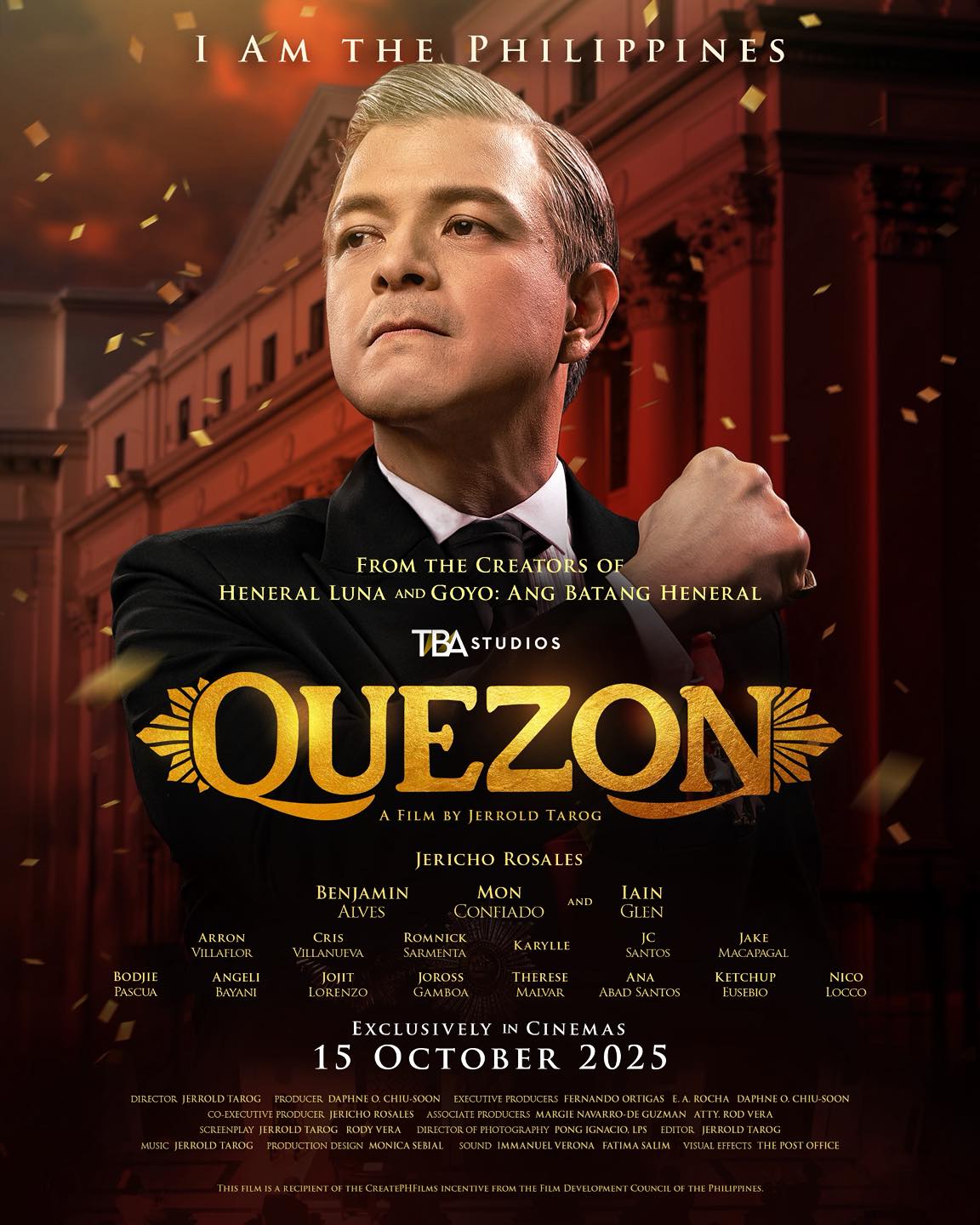
‘I am the Philippines’: A reflection on Quezon and kabayanihan

The Manila Times, Walking History Column by Xiao Chua

July 1, 2025

SOON, Jerrold Tarog’s “Quezon” will come out in the cinemas, the third installment in the ‘bayaniverse’ of TBA Studios. Since the first film, “Heneral Luna” in 2015 and “Goyo: Ang Batang Heneral” in 2018, Dakila, a collective promoting Filipino heroism, has been tapped to conduct a nationwide tour to promote the films under the project “Bayani Ba ‘To” (which alludes to heroes as monuments but also to a question about their heroism), where historians like John Ray Ramos, Alvin Campomanes, Natasha Kintanar and myself lead the discussions. The warts-and-all approach of the films makes them more appealing than the almost hagiographic approach to the teaching of heroism.

Last June 23, 2025, the historians, Dakila and a representative of TBA met to consolidate our insights on how to contextualize “Quezon” (without spoilers).

Answering the question, “Was President Manuel Quezon a bayani?” is more complicated than perhaps asking, “What was his contribution to Philippine history and to us Filipinos?” Arguably, Quezon is the “Architect of the Modern Philippine State.” And he was able to do it because, as a pioneer actual national leader of the country, he assumed a cultural role familiar to the people, a “datu,” whose role in indigenous society is to distribute “karangalan” (honor) and “kaginhawaan” (well-being) and was also the chief bagani (warrior). When the Spanish colonizers came, the datu class became the principalia class, who became the bridge between the people and the colonial masters. The survival of the system rests on negotiating with the colonizer in order to continue governing and providing for the people. This continued when certain elites were given favor by the American imperialists.

Add to this mix, according to fellow Manila Times columnist Van Ybiernas, the fact that a whole generation of potential heroic leaders was wiped out during the Philippine Revolution, like José Rizal, Andres Bonifacio, Marcelo H. del Pilar, Emilio Jacinto, etc. Those who remained in the same patriotic spirit when the Americans came, like Macario Sakay, were wiped out too. That nationalist route would lead to death. And so, Quezon’s generation figured that they should creatively show nationalism in front of the people while patronizing the Americans for survival.

This is the reason why Quezon was described as “janus-faced”: He said one thing to the people, and another to the elite and the imperialists. And since the Americans were the only colonial power to promise independence to their subjects as the Jones Law was passed, nationalism and loyalty to America had no contradiction. This is how Quezon helped create a nation in the face of American imperialism: He had to have transactional relations with the elite and the Americans so he could provide for his people. In his imaging (“papogi”), he created a cult of personality, the heroic datu who facilitates “kaginhawaan,” which is the basis of the patronage politics in our present society.

So yes, there were the two sides of Quezon. The one who told his daughter Zeneida, or Nini, “Never forget the poor.” He was the visionary who put forward “social justice” as the banner cry of his leadership, that there should be a preferential option for the poor. He was radical in his empathy and inclusivity in allowing the women’s vote and the adoption of a national language. He demonstrated the Filipinos’ “kapwa” culture by implementing the eight-hour day and minimum wage, housing projects, and championed human rights by not implementing the death penalty, believing that no Filipino should beg for his life in his administration, and by rescuing 1,300 Jews from the Holocaust.

But he also institutionalized a traditional, patriarchal, transactional populist system which continued colonial dependency and elite democracy. This is Quezon’s contradictory legacy for good (and for bad). I guess we should give credit to where credit is due but also learn from his faults.

His batchmate, Emilio Jacinto, wrote, “Let us seek the light and do not let us be deceived by the false glitter of the wicked.” So, I will leave it to you to answer if Quezon was indeed a bayani. But I would like to end with a quote which Quezon was heard to have said toward the end of his life in reference, I believe, to Sergio Osmeña, his vice president: “Look at that man, why did God give him such a body when I am here struggling for my life? I am Manuel L. Quezon — I am the Filipino people, I am the Philippines.”

Truly, he once represented the Philippines, but now we always mistake loyalty to the leader as loyalty to the country and criticizing the leader as being disloyal to the nation. We have always depended on leaders and strongmen as our heroes. We always ask the question “Bayani ba ‘to?” But the hero we are looking for might be the image in front of us when we look at the mirror: “I am the Philippines, tayo ang Pilipinas, tayo ang bayan, tayo dapat ang bayani.”

“Pero bayani ba talaga tayo?” Let this be both a call for action and an aspiration. We are the Philippines. We have the power to change our country.

WALKING HISTORY

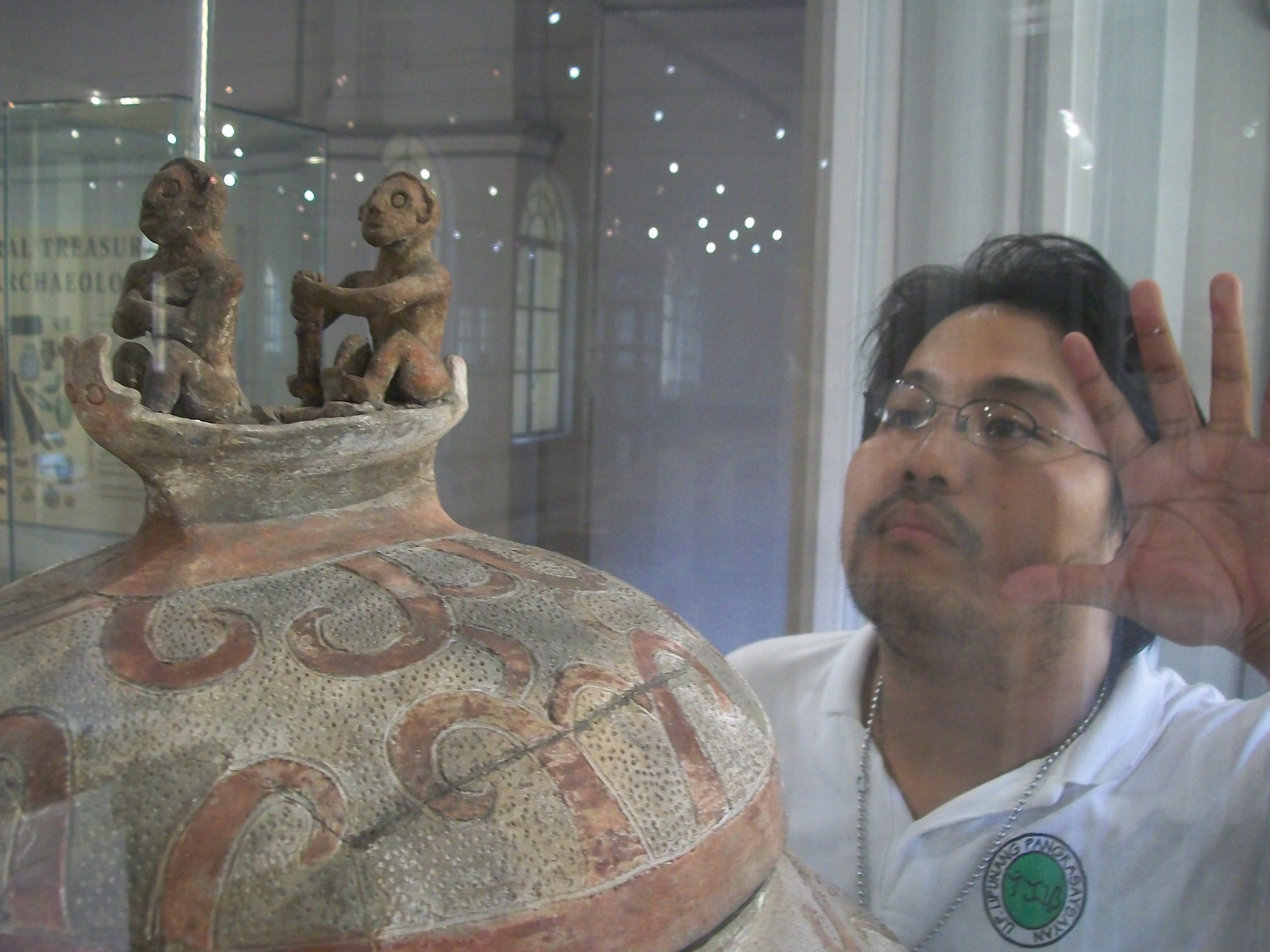
Adoring the Manunggul Jar at the National Museum and learning about the common culture and belief of all Austronesians, the ancestors of Filipinos.

Hi this is Xiao Chua, a student of history.

…and it’s XIAOTIME!

This is my new blog which I created to anticipate the closure of my multiply blog, Ang Tarlakin (winner of the 2007 Wikipinoy of the Year for History) by December.  I would also like to have a more accessible and permanent home for my more serious thoughts.

Earlier today, I toured two sets of people in Luneta and Intramuros — about a hundred or so college students, and then, some kids.  In between being a student and teacher of history, I am a lakwatchero, who uses the spaces around us to teach history.

The past will always be a part of travelling.  Yup.  Everywhere we go, there are remnants and monuments of what used to be.  But to many, the past is irrelevant.  The dictionary definition of History is “the written record of past events,” and since we Filipinos did not keep records before the foreigners came, most of what we have read was their narratives on us in their perspective and language.  We became too harsh on ourselves in the process—thinking we are an inferior, bad people.  But try to view the past in the Filipino perspective, and we will be selling the idea that our best tourism asset is really our people.  I was taught by my mentor, historian Dr. Zeus Salazar, that the root word of our equivalent term for History, Kasaysayan, is “saysay.”  Saysay can mean “story” but it is also a word for “meaning.”  Seeing in the past what is meaningful and relevant to us, the people?  Hmmm, this sounds like a novel idea since we are coming from a perception that history classes are irrelevant and are the best sleeping pills.

Saysay of Lakwatcha

What does Lakwatcha really mean?  Lakwatcha editor Ai Macalintal once asked me this question.  Since I am not an expert on languages, I consulted mentors and friends.  Dr. Nilo Ocampo of the UP Department of Filipino referred me to the Vito Castillo Santos’s “Vicassan’s Pilipino-English Dictionary,” in which it says Lacuacha is a word from the Spanish that means “truancy.”  Truancy???  That explains why, when I asked Dr. Salazar and my friend Prof. Alvin Campomanes of the University of Asia and the Pacific what Lakwatcha meant for them, they both said it’s to loiter, roam around or promenade to shirk from duty.

Not a very positive word, it seems.  But we all know that culture and words are dynamic and the people can redefine them over time.  In this magazine, we can redefine lakwatcha to mean not just a vacation to get away from “the grey and frenzied hurly burly of the city life,” as Jose Mari Chan puts it.  It can also mean to travel and know ourselves as a people by discovering our different and shared histories and cultures.  Another mentor of mine Dr. Vic Villan of the UP Depatment of History, had another theory on how lakwatcha can mean to us.  It can come from the Cebuano “lakaw,” or the Hiligaynon “lakat” and the Tagalog “lakad,” all refers to the act of walking.

Saysay in Lakwatcha

Aside from being a teacher and historian, I am a historian-on-board buses for Linangan Education Trips (which specializes in historical educational tours) which I have been doing since 2006.  With this, I am able to lead students to remember the past in the spirit of the Katipunan’s “peregrinasyon.”  I learned from Dr. Jimmy Veneracion that during the years after the Philippine Revolution of 1896, the veterans of the Katipunan, returned to their battlefields, in groups remembering their fallen comrades, mga kapatid, which they called “peregrinasyon” or pilgrimages (as when we have spiritual journeys to the Holy Land).  When we travel to Fort Santiago, Banahaw, Biak-na-Bato, Mt. Nagpatong in Cavite, Luneta, Pinaglabanan, Corregidor, and many other places around the archipelago, we are honoring those who died before us so we can be free and have the opportunity to be good Filipinos.

Recently, I learned from the other tour company which hires my services, the Heroes Square Heritage Corporation (it owns the beautiful commercial building in front of Fort Santiago and it facilitates Intramuros tours with actors portraying historical personages for young kids) that in European museums, they call tour guides “docents.”  It’s the first time I heard it used in the Philippines.  For Heroes Square, the docent is not just a tour guide but is also a passionate teacher who teaches love of country.  In the next blogs, I hope that you join me as fellow travellers in a “pereginasyon” to know how great a people we are.  It’s time to recognize ourselves in the words of Tito Boy Abunda, “We are Filipinos, we are your best friends in Asia.”

I am proud to be a docent.  I give meaning to lakwatcha.  I am walking history…

This first post is dedicated to Dr. Ambeth R. Ocampo, whose birthday we celebrate tomorrow, for bringing me to the journey of history with his book Rizal Without The Overcoat when I was in grade 5.  Reading him and trying to catch his tone I first realized how I wanted to be a cool history teacher just like him.